
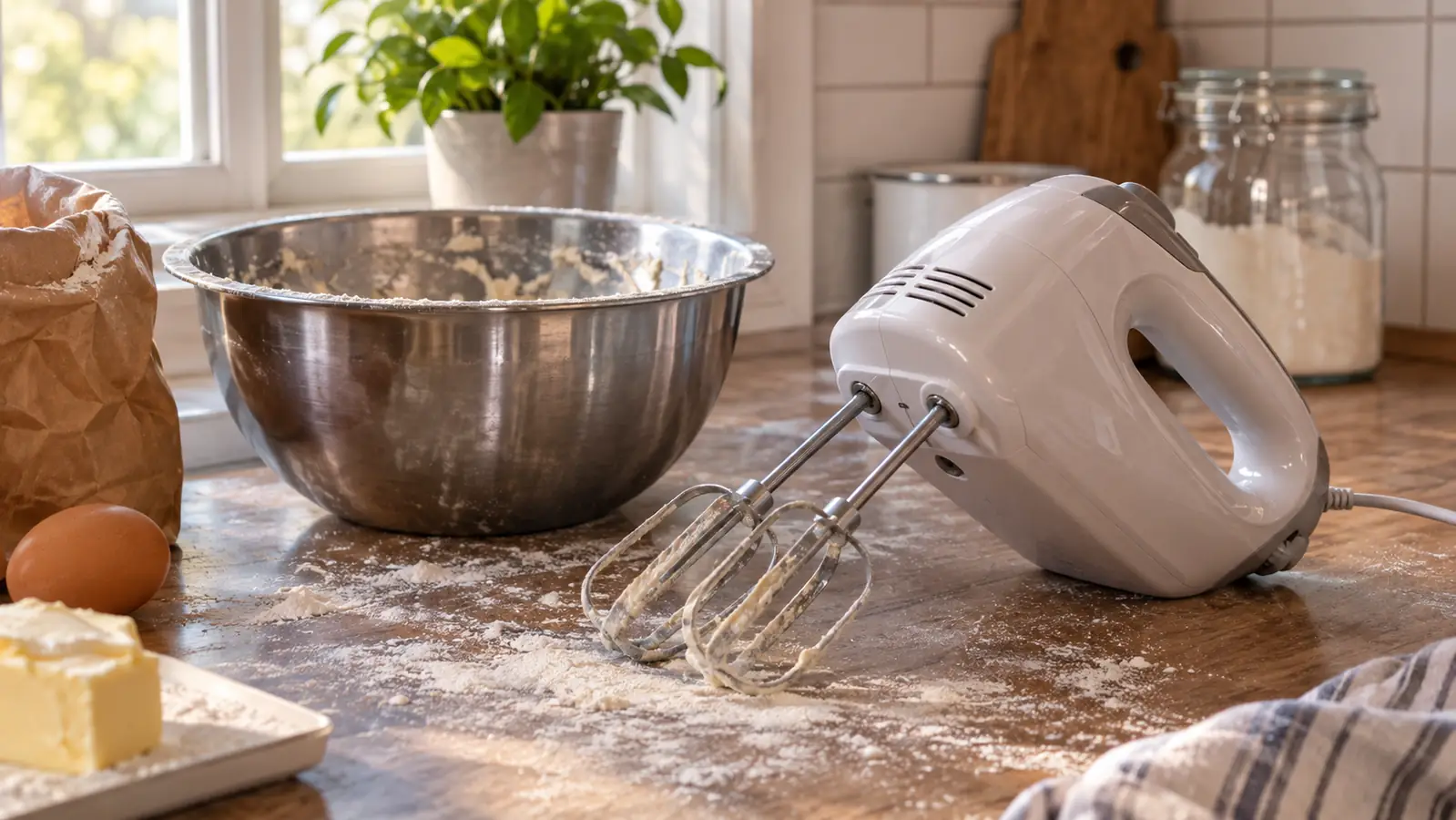
I will tell you straight out what I wish somebody had told me before I bought the KitchenAid 5 Ultra Power Speed Hand Mixer: it is a very good hand mixer, and it is still a hand mixer. It will not knead a double batch of bread dough. It will not whip a quart of cream into stiff peaks in thirty seconds. It will not turn you into someone who bakes more than you already do. What it will do, batch after batch, is beat eggs, cream butter and sugar, fold in chips, and whip small bowls of cream without complaint. I have had mine for a little over a year, bought new myself last September after my old mixer's motor burned out mid-batch, and I have used it most weekends since. That is the honest version, and this is the whole review.
The Quick Verdict
A dependable five-speed hand mixer that handles nearly everything a home baker with a small kitchen needs, as long as you keep expectations reasonable.
Amazon Check Today's Price →A year in, this is the hand mixer I reach for first
If your old hand mixer is struggling through a batch of cookie dough, the KitchenAid 5 Ultra Power Speed Hand Mixer is a solid replacement that will last you through years of weekend baking.
Amazon Check Today's Price on Amazon →How I've Used It
I am Marlene Kowalski. I am 58, I live in northern New Jersey with my husband Ray, and I have baked at home for about thirty years. Most weekends I make something, and every November and December I do a big run of cookies and pies for the family and the parish bake sale. My kitchen is small. I have one standard electric oven that runs about fifteen degrees hot, limited counter space, and no room for the stand mixer I gave to my daughter when we downsized. So when my old hand mixer burned out, the replacement had to earn its spot on the counter.
I bought the KitchenAid KHM512 with my own money in September of last year. Since then I have used it for chocolate chip cookies, sugar cookies, several birthday cakes, banana bread, pound cake, angel food cake, mashed potatoes, whipped cream, and more batches of frosting than I can count. I have also tried things that did not work well, and I will tell you about those too, because that is the part of a review that usually gets left out.
The day my old mixer died was a Saturday in late August. I was halfway through a batch of peanut butter cookies for Sunday dinner when the motor made a sound I had never heard it make before, a kind of grinding whine, and then the room smelled like burning dust. I finished that batch with a wooden spoon and a sore arm, and I told Ray that was it, I was getting a decent mixer this time. I did not want a stand mixer. I had given mine to my daughter when we downsized, and I had no counter space for another one. I wanted a hand mixer that would last, and the KitchenAid name was the one I trusted. So in September I bought this one, and it has been on my counter or in my drawer ever since. The real test came in November and December. I made about forty dozen cookies for the parish bake sale plus the trays for the family, and the mixer ran for hours most weekends. It got warm to the touch, but never hot enough to worry me, and the beaters never loosened in the socket. That is the test that matters to me. A mixer that survives December is a mixer that will last.
What Nobody Tells You First
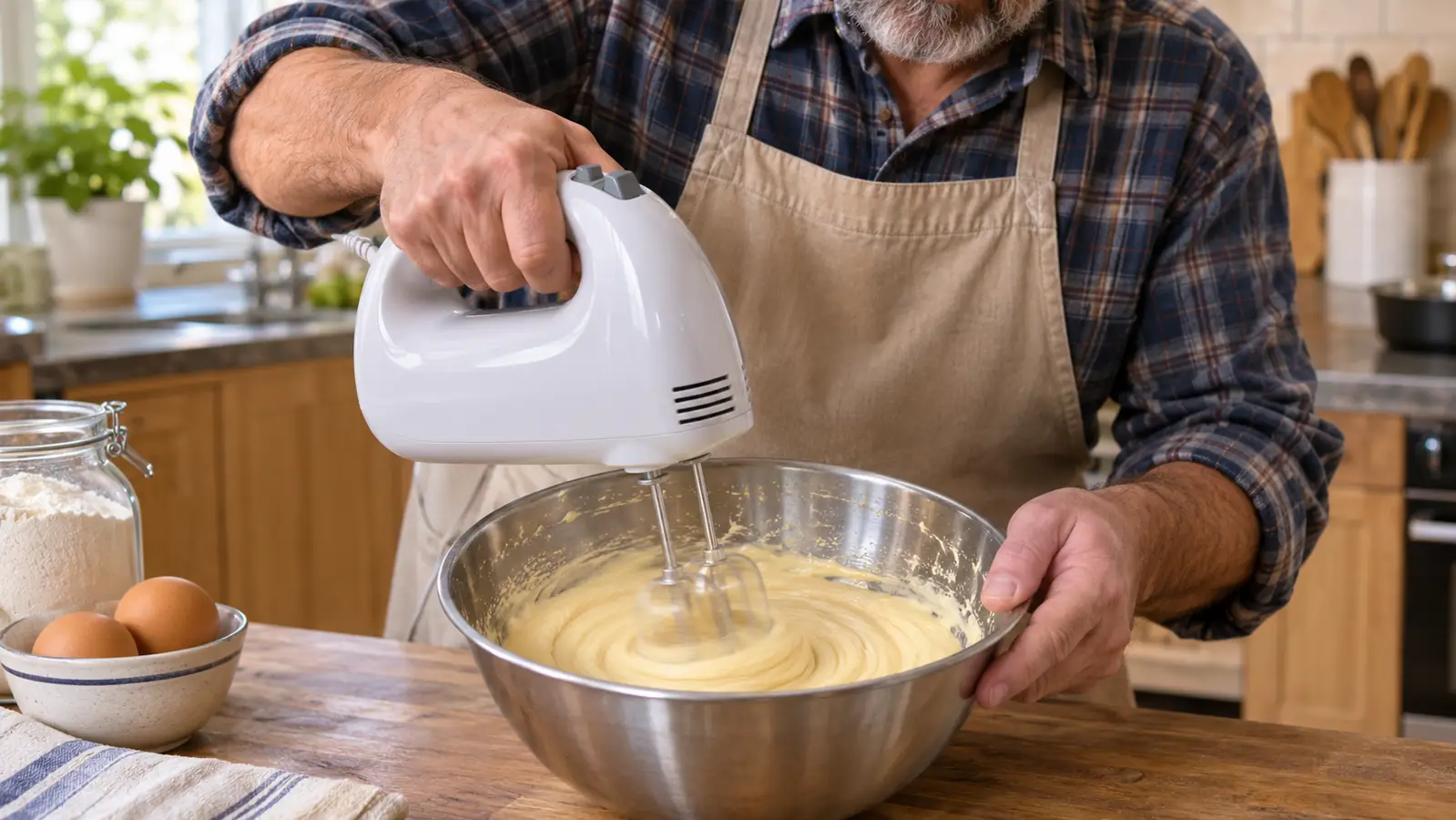
The first thing nobody tells you is that a hand mixer is a two-handed tool. You hold the mixer with one hand and the bowl with the other, and if you are used to a stand mixer walking away while it works, that takes adjusting. You cannot walk across the kitchen and preheat the oven while the mixer runs. You are standing there, holding it, for as long as it takes. For most of my baking that is fine. It is, in fact, the whole point of a hand mixer in a small kitchen. But it is worth knowing before you buy.
The second thing nobody tells you is that the speed dial matters more than the wattage. This KitchenAid has five speeds and push button controls, and 60 watts of power. On paper that sounds modest. In practice, the five speeds are genuinely useful, and speed one is the one I use most. That is where I fold in chocolate chips and nuts without crushing them, and where I start whipping cream so I do not end up with butter. My old mixer had three speeds and they were all too fast. This one has a low speed that is actually low.
The first time I used it, I made the mistake of lowering the beaters into the bowl before I turned it on. The mixer jumped in my hand and sprayed flour across the counter. You learn fast to start with the beaters in the ingredients, or at least buried in them, and to start on speed one before you move up. I also learned to hold the bowl with my left hand and keep it close to my body, because a hand mixer pulls to the side when the batter is thick. It sounds like common sense, but common sense is easier to see in hindsight than in the moment. After a week of weekend baking, I stopped thinking about any of it. The motions became automatic, the way they do with any tool you use often.
At 2 pounds, it is light enough that I can whip a bowl of cream without my arm complaining. But you are still holding it, and for a full batch of buttercream, I switch hands halfway through. That is not a complaint about the mixer. It is just what a hand mixer is. If you are used to a stand mixer doing the work while you measure the next ingredient, this will take some getting used to. You stand at the counter, you hold the mixer, and you watch the bowl. I have learned to do my measuring before I start mixing, so everything is ready when I need it.
Speed one is the one I use most. My old mixer had three speeds and they were all too fast.
The Speeds, Batch by Batch
Speed one is for folding in chips, nuts, and flour. Speed two handles creaming butter and sugar for cookies. Speed three is where I do most cake batters. Speed four whips cream and egg whites for a single batch of frosting. Speed five is for when I need volume fast, like the meringue for a lemon meringue pie, and even then I only use it for a minute or two before dropping back down. The push button controls are simple and easy to clean, which matters to me because I am usually covered in flour by the time I need to change speeds.
The lockable swivel cord is another detail I did not expect to care about. It locks in place so it stays out of the bowl while I mix, and I can swing it to whichever side I need. In a small kitchen, a cord that flops into the batter is not a small annoyance. This one stays put.
The detachable spindle is the feature I appreciate most. When I am done, I press the button, pull the beaters out, and wash them by hand. Nothing about this mixer requires me to wrestle with a latch or wash the whole body under the tap. The beaters are stainless steel Turbo Beater accessories, and they have held up through a year of heavy use without bending or flaking. I cannot say that about my old mixer.
Take the chocolate chip cookies I made for my grandson's birthday last month. The butter and sugar creamed on speed two in about three minutes, the eggs went in one at a time on speed two, and then I switched down to speed one to add the flour and the chips. The dough came together without a single chip getting crushed, which is exactly what speed one is for. My old mixer had three speeds and they were all too fast, so the chips always ended up broken and the dough was overmixed by the time the flour was in. That one batch is the whole argument for this mixer in miniature.
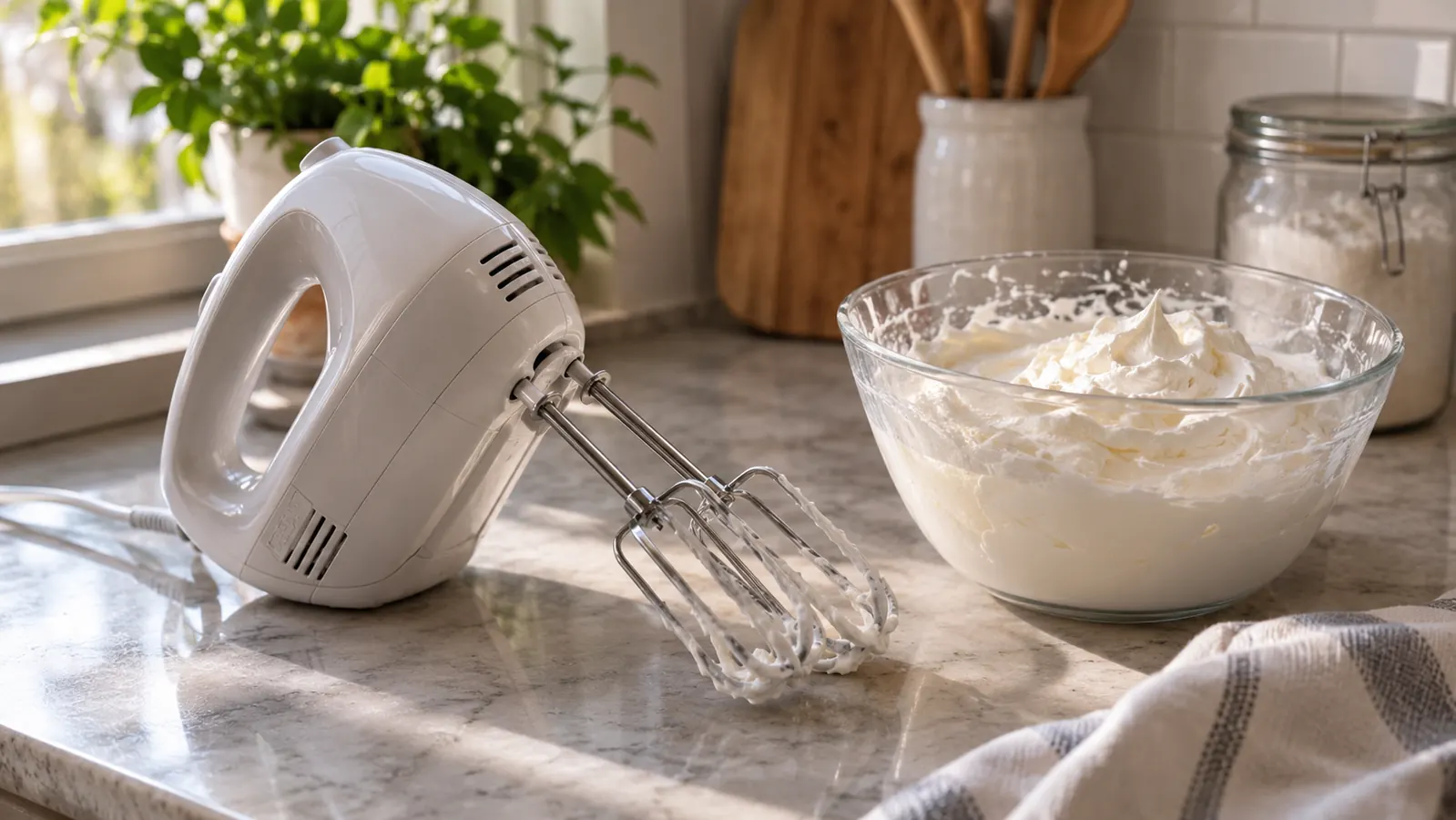
The whipped cream for the strawberry pie at Easter worked the same way. I started on speed one, moved up to speed four once the cream began to thicken, and had soft peaks in about two minutes. It was not the over-whipped, grainy mess I used to get with my old mixer. For the lemon meringue pie in March, speed five got the egg whites to stiff peaks faster than I expected, and the meringue held its shape on top of the pie all the way to the table. Those are the moments that make me glad I chose this one.
Where It Runs Out of Steam
Now the honest part. There are three things this mixer will not do, and you should know them before you buy.
First, it will not handle a double batch of stiff cookie dough gracefully. A single batch of my chocolate chip cookie dough is fine. A double batch, the kind I make when I am baking for the parish bake sale, is too much for it. The first time I tried it was a Saturday in October, the weekend before the bake sale. I had doubled my usual recipe, a full pound of butter and close to five cups of flour, and I thought the mixer would power through. It did not. By the time the last cup of flour went in, the dough was stiff enough that the beaters were barely turning, and the mixer started to strain in a way I did not like. I finished the last of it with a wooden spoon, and the cookies came out fine. But I learned my lesson. From then on, I split double batches in half and mix them one at a time. It takes a few extra minutes, and it saves the mixer. That is not a defect in the mixer. It is the nature of a hand mixer. But if you regularly make double batches, you need to know that you will be doing some of the work yourself.
Second, it is not a stand mixer substitute for bread dough. I tried it once with a half batch of my white bread dough, just to see, and it was a mistake. It was a Sunday in February, and I had a half batch of white bread dough for dinner rolls. I thought I would save my hands the work and let the mixer knead it. That lasted about a minute. The dough wrapped itself around the beaters and climbed up toward the motor, and the mixer made the same strained sound it had made with the cookie dough. I turned it off, pulled the dough off the beaters by hand, and kneaded it the way I always have. The rolls were fine. The experiment was a failure, and I am glad I tried it once so I know not to try it again. I do not hold this against the KitchenAid. I hold it against the idea that one tool can do everything. For bread, I use my hands and a bowl, and the mixer stays in the drawer.
Third, the bowl matters. Because you are holding the mixer, the bowl has to stay put, and a slippery stainless steel bowl will spin on the counter. My solution is a damp kitchen towel under the bowl, which works perfectly. I keep a folded dish towel on the counter next to my mixing bowl, and I set the bowl on top of it. The towel grips the bowl and the counter, and the bowl stays put even when I am mixing a stiff batch of cookie dough. My daughter uses a bowl with a rubber ring on the bottom and swears by it. Either way works. What does not work is setting a plain stainless bowl on a dry counter and hoping for the best. I learned that the first week, when a bowl of cake batter spun halfway around the counter and I caught it just before the edge. It is a small thing, but it is the difference between a pleasant mixing session and chasing a bowl across the counter.
The Pros and Cons
What I Liked
- Speed one is genuinely slow, so folding in chips and starting whipped cream is easy
- Five speeds with push button controls, and the speeds are actually useful
- Lockable swivel cord stays out of the bowl and swings to either side
- Detachable spindle with a single-handed button makes cleanup simple
- Stainless steel Turbo Beater accessories have held up through a year of heavy use
- Light at 2 pounds, easy to hold for a full batch of frosting
Where It Falls Short
- A double batch of stiff cookie dough is too much for it
- Not a stand mixer substitute for bread dough, which I learned the hard way
- You have to hold it the whole time, so you cannot multitask the way you can with a stand mixer
- A slippery bowl will spin on the counter unless you put a towel under it
- No storage case, so the beaters rattle in the drawer
Who This Is For
This mixer is for the home baker who makes single batches of things, who has a small kitchen, and who does not want a stand mixer taking up the counter. It is for the person who bakes cookies on a Sunday afternoon, makes a birthday cake for a grandkid, and whips cream for a pie without dragging out a bigger machine. It is for the baker who, like me, learned to make do in a small kitchen and wants a tool that does its job without fuss.
It is also for the person who is replacing an old hand mixer and wants one that will last. The KitchenAid brand name is on this for a reason. Mine has been through a year of weekend baking, a November and December of constant use, and it still runs like the day I bought it. The motor has not overheated, the speeds have not stuck, and the beaters are as straight as they were in the box. That is the kind of reliability I care about at 58, when I would rather bake than repair.
Who Should Skip It
Skip this mixer if you bake double batches of stiff dough regularly, if you make bread often, or if you want to start a batch and walk away. None of those are failures of this particular mixer. They are jobs for a different tool, and pretending otherwise will only frustrate you. A hand mixer is a hand mixer, and the KitchenAid 5 Ultra Power Speed Hand Mixer is a very good one. It is not a stand mixer, and it is not a bread machine.
Skip it too if you are hoping a new mixer will make you bake more. It will not. What it will do is make the baking you already do easier, and for me, that is exactly what I wanted.
If your mixer is struggling, this is the one I would buy again
After a year of weekend baking, the KitchenAid 5 Ultra Power Speed Hand Mixer is the tool I reach for first, and the one I would replace with the same model tomorrow.
Amazon Check Today's Price on Amazon →