
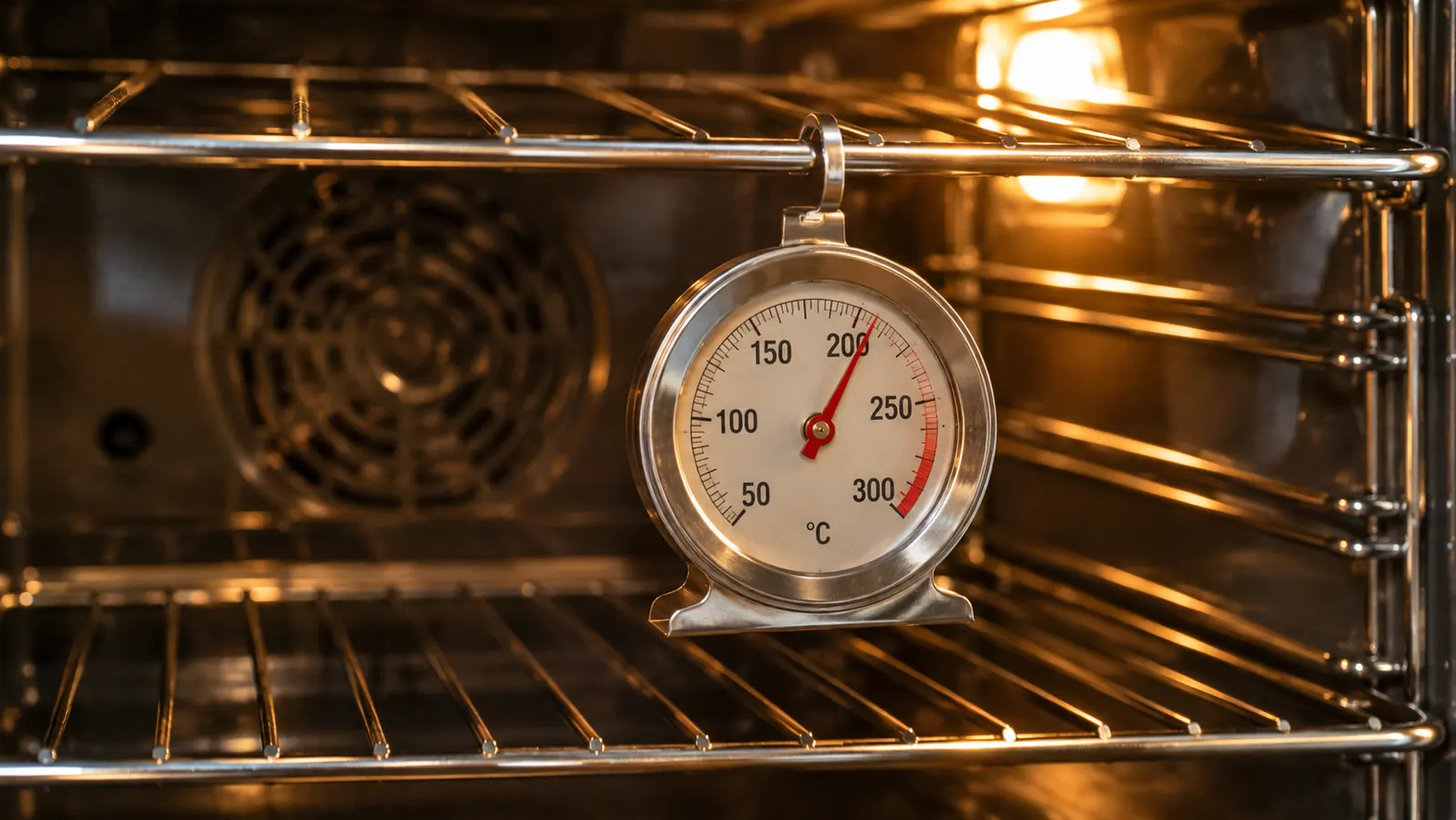
If your cookies burn on the bottom while the tops are still pale, your oven may be running hot. Mine was. A Taylor Analog Oven Thermometer showed me the truth: my dial said 350, but the oven was closer to 365. That 15 degrees explained a lot of ruined batches. I am Marlene Kowalski, and I have been baking at home for about thirty years, most weekends plus a big run of cookies and pies every November and December for the parish bake sale. My kitchen is small, with one standard electric oven, and that oven runs a little hot. This is the method I use to check it, adjust for it, and keep it honest.
Before I bought my Taylor thermometer about two years ago, I blamed my recipes. I swapped flours, chilled dough longer, and moved racks around. The real problem was simpler: the oven was not at the temperature the dial claimed. An oven thermometer does not fix a broken oven, but it tells you what is actually happening inside, and that changes how you bake. Once you know the offset, you can adjust the dial and get back to the part you enjoy.
Find out how hot your oven really runs
The Taylor Analog Oven Thermometer is the tool I keep on my middle rack. It reads from 100F to 600F, has a large dial that is easy to read through the door, and it has held up through about two years of daily use in my kitchen. Check today's price on Amazon.
Amazon Check Today's Price on Amazon →Step 1: Put the thermometer where you actually bake
Start with a cold oven. Place the Taylor thermometer on the middle rack, toward the center but slightly forward, because that is where most of my baking happens. If you bake a lot of cookies on the upper third, test there too. The point is to measure the air around your food, not the metal of the rack or the back wall. The position matters more than people think. Ovens cycle on and off, and the temperature swings above and below the set point. A thermometer pressed against the back of the oven will read hotter than the spot where your cake pan sits. Give it a few inches of clearance on all sides. I slide mine near the front edge of the middle rack, just behind the lip, so I can read it through the door without opening it.
If you bake on two racks at once, test each rack separately. In a small kitchen like mine, I rarely use more than one rack at a time, but the difference between the top and middle rack can be significant. Knowing which rack runs hot lets you rotate pans or swap their positions halfway through the bake.
One more thing: do not test with a pan of food in the oven. A large roast or a sheet of cookies changes the air temperature and can make the reading less useful. I test with an empty oven, then I know the baseline. Once I know the baseline, I can adjust for a full oven by feel and by checking the thermometer during the bake.
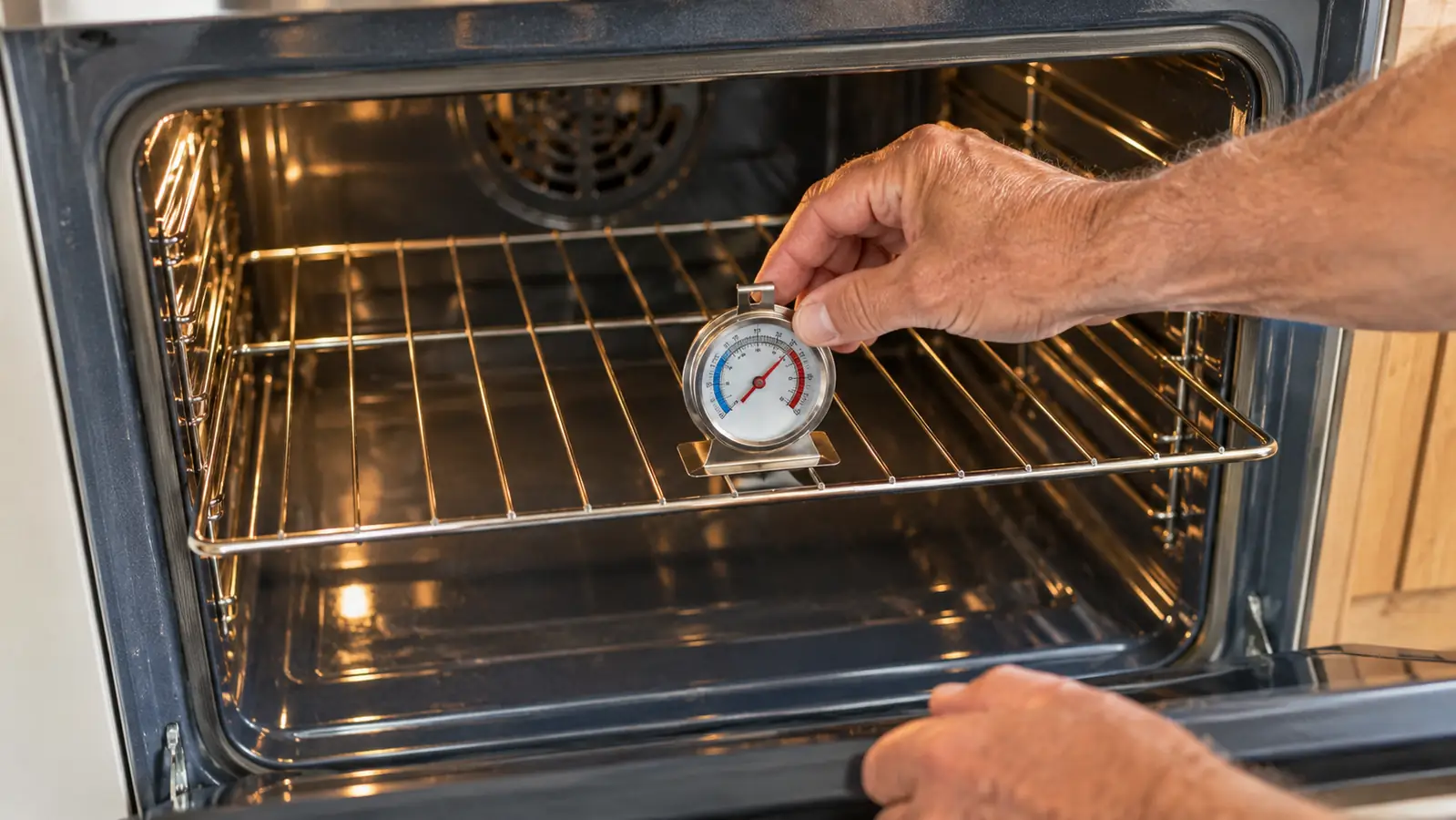
Step 2: Preheat long enough for the oven to settle
Set the oven to 350F and give it a full 20 to 30 minutes after it beeps. The beep only means the air near the sensor reached the set point. The walls, racks, and floor are still warming up, and the temperature will keep moving for a while. If you check too soon, you will chase a number that has not settled yet. This is where my oven first showed its personality. At the 20 minute mark, the Taylor thermometer read about 365. At 30 minutes, it was still around 365. That consistency told me the oven was running hot, not just slow to settle. If the reading keeps climbing or dropping, give it another 10 minutes before you trust it.
Use the same rack position every time you test. If you move the thermometer between tests, you are comparing different spots, not different temperatures. I keep mine on the middle rack, slightly forward, and I test at that same spot every time. Consistency turns a single reading into a reliable pattern.
If you have an older oven like mine, the temperature may swing more than a newer model. I have seen mine climb to 375 before dropping back to 355 while set at 350. That is normal. What matters is the average over the bake, not the highest or lowest point. The thermometer helps you see the range, and the range tells you how much patience you need.
Step 3: Read the thermometer without letting the heat out
The Taylor thermometer has a large dial with clearly marked cooking zones, and I can read it through the glass door most of the time. If I need a closer look, I open the door just a crack, read quickly, and close it. Every second the door is open, the oven loses heat, so a long look gives you a reading from a cooler oven. Do not pull the thermometer out of the oven to read it. The temperature will drop the moment it hits the kitchen air, and you will be measuring the room, not the oven. Leave it in place and read it where it sits.
If the dial is hard to see from your height, use a small flashlight or step stool instead of moving the thermometer. If the oven has a window that darkens with grease, clean it before you test. A clean pane makes it much easier to read the dial without opening the door. I wipe mine with a damp cloth and dry it well before the big holiday bake, when I am checking the temperature constantly.
Take the reading at the same point in the preheat cycle each time. I check mine at the 25 minute mark, after the oven has had time to settle. If I checked at 10 minutes, I would see a lower number and think the oven was running cold. Same oven, same setting, different moment in the cycle. Pick a moment and stick with it.
Step 4: Compare the reading to the dial and adjust
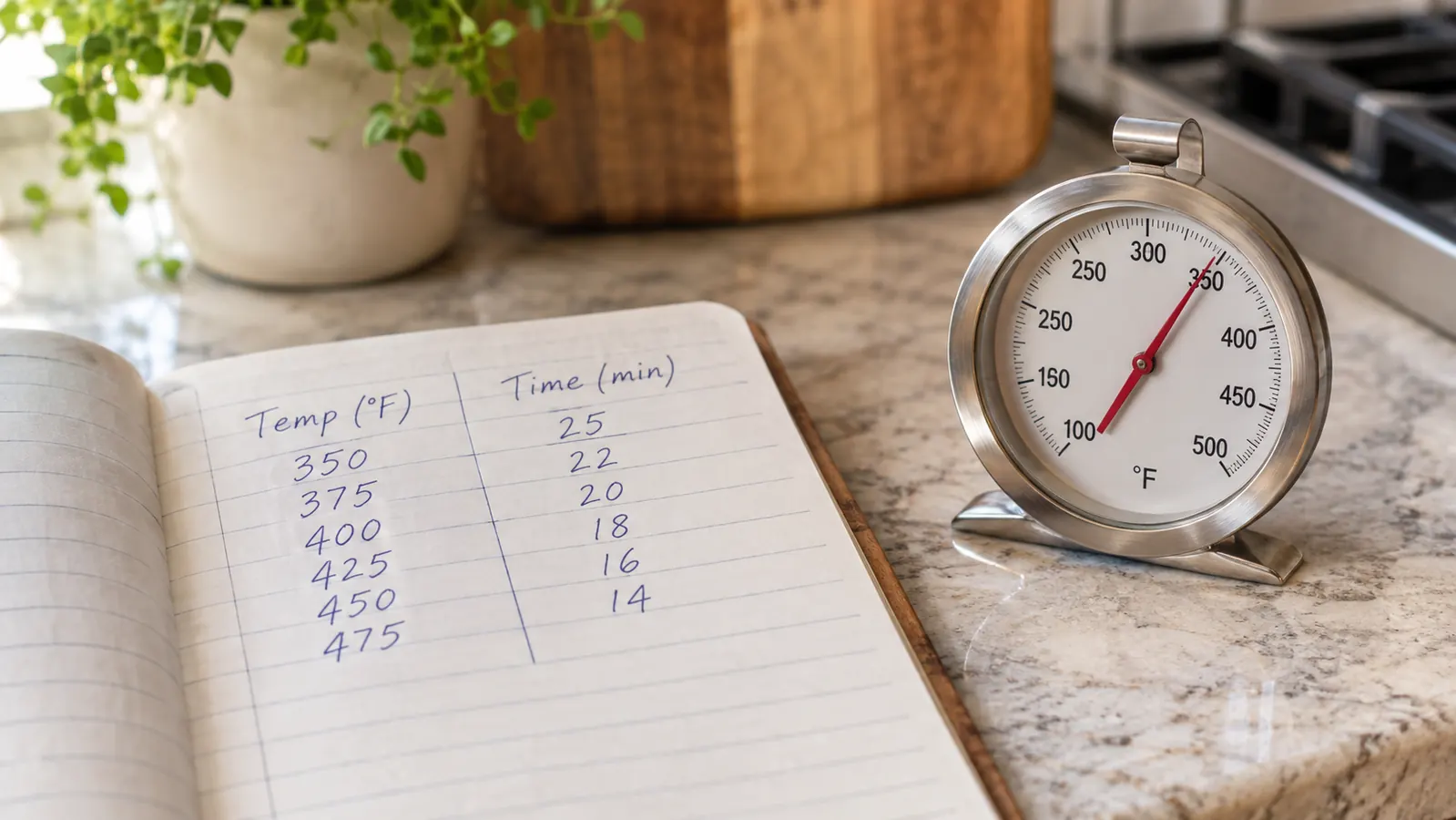
Once the oven has settled, compare what the thermometer says to what the dial says. In my oven, the difference is about 15 degrees. When a recipe calls for 350, I set the dial to 335. When it calls for 375, I set it to 360. The adjustment is the same every time, because the offset is consistent. Write the offset down. I keep a note card taped inside the cabinet above my oven with the numbers for 325, 350, 375, and 400. That way I do not have to do the math while I am holding a bowl of batter.
If the thermometer shows a different offset at different temperatures, make a small table. Some ovens are more accurate at 350 than at 425, and knowing that is useful. Do not adjust the oven's internal calibration unless you are comfortable doing that. Many ovens have a hidden calibration setting, but I prefer to leave mine alone and simply set the dial lower. The Taylor thermometer gives me the number I need without me touching anything inside the oven.
If your oven is more than 25 degrees off, it may be worth a service call. Remember that the offset can change with the season. In the winter, my kitchen is cooler and the oven seems to work harder to hold its temperature. In the summer, with the air conditioner running, the oven behaves a little differently. I do not redo the whole test every season, but I keep an eye on the thermometer during the first bake of each season. If you share your kitchen with other bakers, put the note card where everyone can see it. My husband Ray used to set the dial to whatever the recipe said. Now he checks the card first. It saves a batch of cookies every single year.
Step 5: Recheck over several bakes before you trust the new numbers
One reading is a clue, not a conclusion. I tested my Taylor thermometer at 325, 350, and 375 over the course of a week, and the offset stayed close to 15 degrees. If your readings bounce around, check the thermometer placement and make sure it is not touching the rack or the wall. Then run the test again on a different day. After about two years, I still check mine a few times a year. Ovens drift as they age, and a thermometer that was accurate in January can be off by August. I also check it before the big holiday bake, because that is when I need it most. A 15 minute test is worth the time before a weekend of cookie trays.
Keep a simple record of what you find. I jot the date, the set temperature, and the thermometer reading in the margin of my recipe box. Over time, that list tells me whether my oven is stable or slowly drifting. It also helps me explain to Ray why I set the dial to 335 when the recipe says 350.
Do not expect the thermometer to fix every baking problem. If your oven is 50 degrees off, or if the temperature swings wildly, the thermometer will only document the problem. It is still worth knowing, because you can adjust, but a very unreliable oven may need a repair or replacement. The thermometer is a tool for understanding, not a cure-all. One more note: when I first started testing, I expected the thermometer to agree with the dial. It did not, and that bothered me for a day. Then I remembered that the dial is just a guess from the factory. The thermometer is the one telling the truth. Once I accepted that, the adjustment became easy.
What Else Helps
An oven thermometer is the first step, but it works best with a few honest habits. Bake on the middle rack unless the recipe says otherwise. Rotate pans halfway through when the oven has a hot spot. Use a timer and trust the thermometer over the dial. And keep a simple log of what you baked, at what setting, and how it came out. After a few weeks, you will know your oven the way you know your own hands.
The Taylor thermometer has not made my oven perfect. The back corner still runs hotter than the front. But knowing the offset means I can plan around it, and my cookies have stopped burning on the bottom. That is the whole job of a good oven thermometer: it turns a mystery into a number you can use.
One more habit that helps me: I set the oven 15 minutes before I need it, even when the recipe says to preheat first. That extra time lets the oven settle before the pan goes in. It also gives me a chance to glance at the thermometer and confirm the offset is still what I expect. If the reading looks off, I can adjust before I mix the batter.
The day my Taylor thermometer showed 365 when the dial said 350, I stopped blaming my recipes.
Give your oven a fair test this weekend
If your cookies are burning on the bottom or your cakes are doming in the middle, check the actual temperature before you change your recipe. The Taylor Analog Oven Thermometer is the same one I have used for about two years, and it reads from 100F to 600F with a large dial that is easy to read through the door. Check today's price on Amazon.
Amazon Check Today's Price on Amazon →